
Why Small Teams Win and What This Teaches Us About Product Management
There is a widespread belief in growing organisations: if results are slowing down, the solution is to scale the team. More people, more speed.
Sounds logical.
It is also wrong.
And product management usually feels the consequences before any other function.
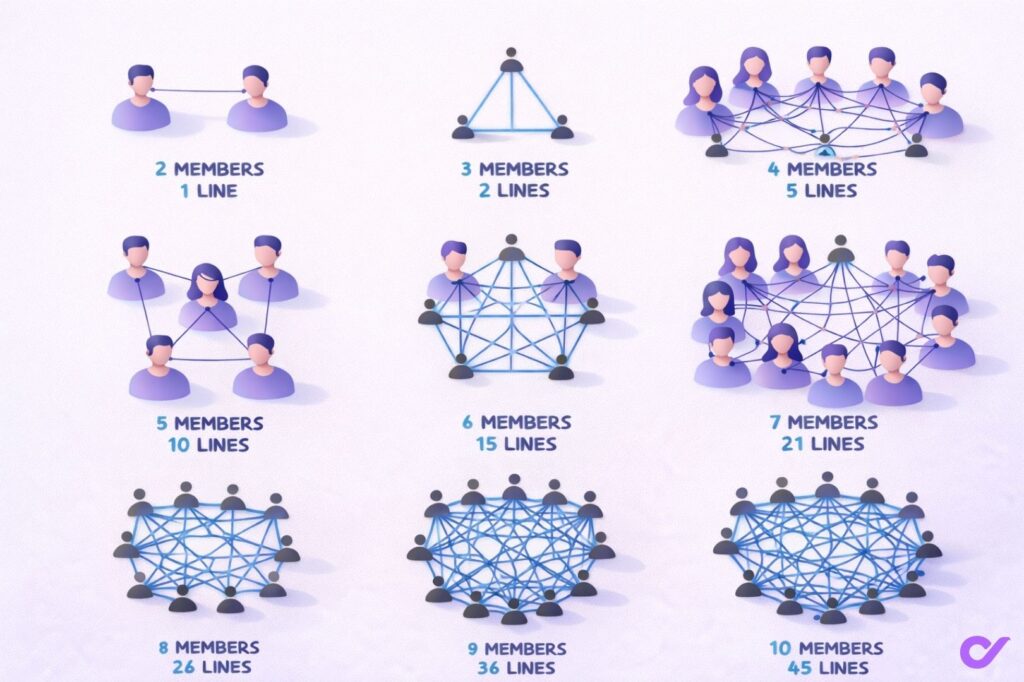
The visuals above illustrate a simple yet powerful truth: as teams grow, communication complexity increases exponentially, not linearly.
With two people, there is a single communication line.
With five, there are ten.
With ten, the number jumps to forty-five simultaneous communication paths.
This follows a well-established formula used in organisational theory and software engineering:
n(n − 1) / 2, where n represents the number of people in the team.
In real life, this translates into more meetings, more messages, more dependencies, more misalignment and more rework. All the invisible forces that slowly erode the effectiveness of product management.
The hidden cost of communication in large teams
The problem is not talent.
It is not effort.
It is coordination.
As early as the 1970s, Frederick Brooks highlighted this dynamic in The Mythical Man-Month: adding people to a late project tends to make it even later. Decades later, organisational research continues to confirm the same pattern.
Studies by McKinsey show that modern knowledge workers spend, on average, around 60% of their time on communication-related activities, such as meetings, emails and alignment rituals. In oversized or poorly designed teams, this percentage is often even higher, leaving little room for meaningful value creation.
In product management, this usually shows up as:
Small teams are not fragile. They are stronger.
Small teams win because they reduce coordination costs.
They operate with clearer goals, higher trust and genuine autonomy.
It is no coincidence that companies like Amazon popularised the famous two-pizza team rule. If a team cannot be fed with two pizzas, it is probably too large.
In practice, lean teams enable:
These are the foundations of mature product management, focused on impact rather than output.
The role of product management in this context
Here is the critical point: small teams do not work without strong product management.
When teams are lean, there is no room for ambiguity. Strategy must be explicit. Priorities must be sharp. Decisions must be directly connected to business outcomes.
This is where many organisations fail. They reduce team size, but keep:
The result is frustration on both sides: leadership and teams.
How Devovea helps organisations build small, effective teams
At Devovea, we regularly work with companies that believe they need more people, when what they truly need is more clarity.
Through our product management services, such as the 360 Diagnosis, Executive Advisory and CPO-as-a-Service, we help organisations:
This is not about doing less. It is about doing better, with less noise and more impact.
Fewer people. Better results.
Small teams are not a constraint.
They are a strategic choice.
When well designed and supported by strong product management, they move faster, learn faster and deliver more value.
And ultimately, that is what truly matters.
Sources:
➥ Brooks, Frederick P. The Mythical Man-Month. Addison-Wesley. https://amzn.to/3YXjDws
➥ PMI® Global Congress 2010. Leybourne, S. A., Kanabar, V., & Warburton, R. D. H. Understanding and overcoming communications complexity in projects. https://www.pmi.org/learning/library/overcoming-communications-complexity-ambiguity-projects-6631
➥ McKinsey Global Institute. The Social Economy: Unlocking Value and Productivity through Social Technologies. https://www.mckinsey.com/capabilities/mckinsey-digital/our-insights/the-social-economy
➥ Vance, S., & Meyer, M. (2025). The 2-pizza-rule: Why small teams win and how to build them. https://amzn.to/4sGXtfV
➥ Harvard Business Review. Why Teams Get Nothing Done. https://hbr.org/2015/03/why-teams-get-nothing-done
➥ Harvard Business Review. Too Many Teams? https://hbr.org/2017/09/too-many-teams
➥ Amazon. Two-Pizza Team Rule. https://aws.amazon.com/podcasts/aws-podcast/110-c-suite-strategies-for-leading-significant-change
Larger teams do not scale results. They scale complexity.
Build lean, clear teams focused on real impact
As teams grow, communication complexity explodes, decisions slow down and delivery loses focus.
Devovea helps you structure product management to work with small, autonomous teams that are tightly aligned with business strategy.
Less noise, more clarity, better decisions and execution that truly delivers value.
This is not about reducing people. It is about designing teams and processes that work in the real world.


